Tanzanite: Blue-Violet from a Single Place on Earth
Found in one small corner of East Africa and nowhere else, tanzanite is one of the rarest gems of our time. Its colour holds the moment just after sunset, when blue turns to violet.
BY THE DIMIRA JOURNAL · · 5 MIN READ
Some gemstones have been treasured for thousands of years. Tanzanite was discovered only in 1967.
High in the Merelani Hills of northern Tanzania, within sight of Mount Kilimanjaro, crystals of an unfamiliar blue-violet were found in the earth. Geologists searched the world for another source. There was none. To this day, every tanzanite ever set in jewellery has come from this one narrow seam of ground, a few kilometres long.
That is the first thing to know about tanzanite. It is a gemstone of a single place.
A colour that will not stay still
Hold a tanzanite and turn it slowly in your hand. From one angle it is a deep, velvety blue. Tilt it, and violet rises to the surface. Look closely, and you may catch a warm flicker of plum at its edges.
Gemmologists call this pleochroism: a crystal that shows different colours along different directions. Tanzanite shows it more beautifully than almost any other gem. Light matters too. In cool daylight the stone leans towards sapphire blue; by candlelight or the soft glow of an evening lamp, it turns richer and more violet.
It is why no photograph quite captures it, and why tanzanite always seems more alive in person.
Named for its homeland
Within a year of its discovery, the stone was given the name it still carries: tanzanite, after the country that is its only home. Few gemstones are so completely tied to one landscape, and wearing one is wearing a small piece of East Africa itself.
In 2002, tanzanite joined the official list of birthstones for December, alongside turquoise and zircon. It was the first new birthstone added in nearly a century.
Choosing your tanzanite
The most prized tanzanites show a saturated blue-violet: never washed out, never too dark. Look for:
- Colour first. A rich, even tone is worth more than size. Paler stones have a softer, lavender charm of their own.
- Brilliance. A well-cut tanzanite should glow from within, with light returning from every facet.
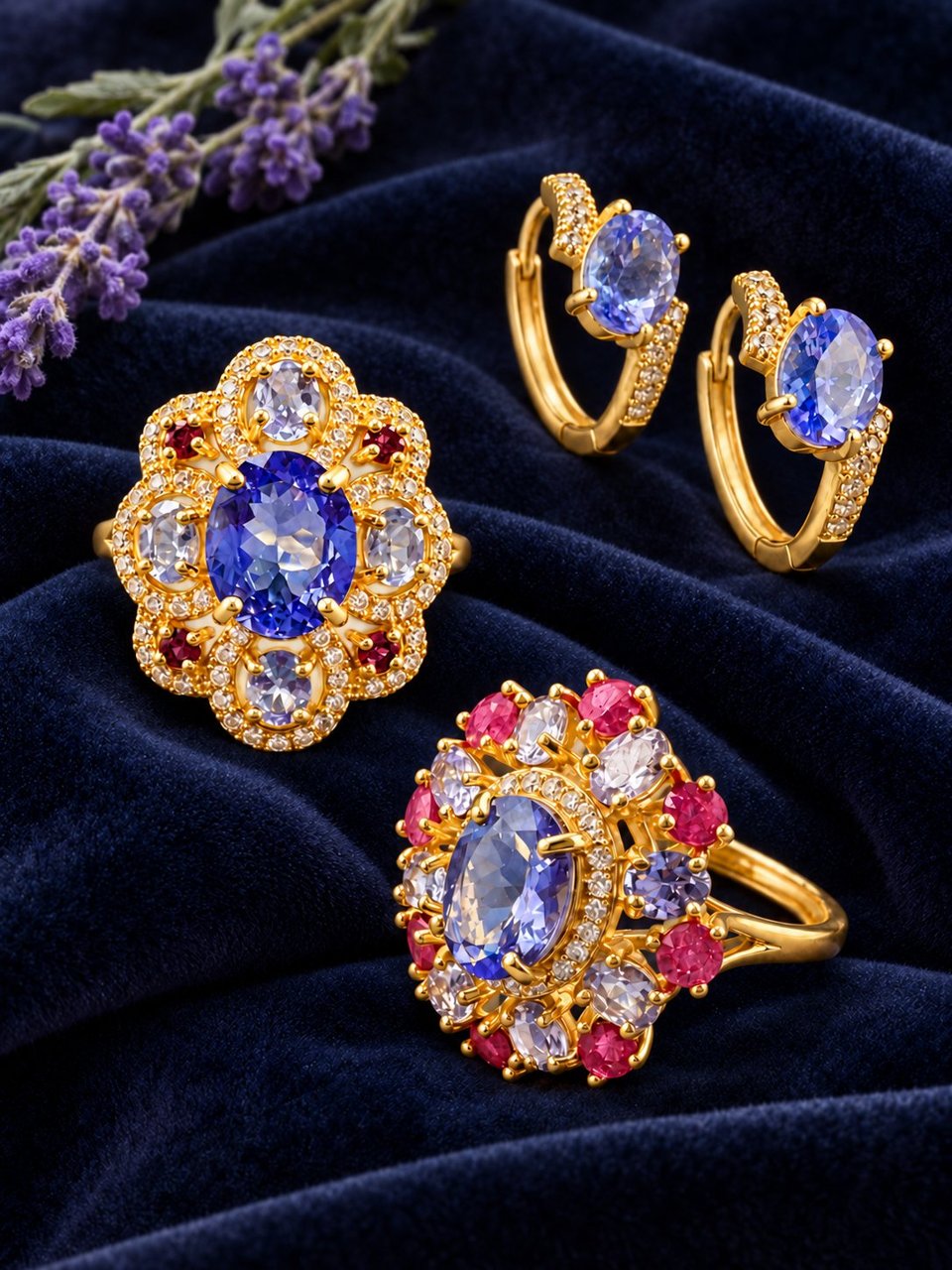
- The setting. Warm gold brings out the violet in the stone; cooler tones lean it towards blue. In a vintage-inspired setting, surrounded by fine detail, tanzanite looks as though it has been worn and loved for generations.
How to wear it
Tanzanite is a gemstone of evening. Let it be the single point of colour against black, ivory or deep navy. A pair of tanzanite studs gives a quiet signature to everyday dressing. A cocktail ring, set with a halo of smaller stones, carries the drama after dark.
For a bolder look, pair it with its natural companions in colour: the warm red of garnet or ruby, which makes the blue-violet glow even deeper.
Caring for tanzanite
With a hardness of 6 to 7 on the Mohs scale, tanzanite is softer than sapphire and deserves a little care.
- Put it on last and take it off first, after perfume and lotion.
- Remove it for sport, gardening or heavy work, and avoid sudden temperature changes.
- Clean it gently with lukewarm water, mild soap and a soft brush. Never use an ultrasonic cleaner.
- Store it on its own, in a soft pouch or a lined box, away from harder gems that could scratch it.
Treated with this gentle respect, a tanzanite will keep its colour and its glow for a lifetime.
A gemstone from one place on earth, for the one person it was meant for.